
Choosing the right sign material is not simply a question of what is cheapest or easiest to get hold of.
The substrate affects how a sign looks, how easily it can be manufactured, how straightforward it is to install and, most importantly, how well it performs once it is out in the real world.
For sign makers, choosing incorrectly can mean warped panels, damaged corners, premature replacement or an installation that simply does not suit the environment.
Four materials regularly considered for flat panel signage are ACM, solid aluminium, Foamex and Correx.
They can all produce effective signage, but they are designed for very different jobs.
This guide compares ACM vs aluminium vs Foamex vs Correx, including their strengths, weaknesses and the applications where each material makes the most sense.
Quick Comparison: ACM vs Aluminium vs Foamex vs Correx
|
Material |
Best Suited To |
Outdoor Durability |
Ease of Fabrication |
Relative Cost |
Key Consideration |
|
Solid Aluminium |
Permanent and demanding external signage |
Excellent |
More demanding |
£££ |
Strong and durable, but heavier and harder to process |
|
ACM |
General external and internal signage |
Very good when correctly specified |
Easy |
££ |
Excellent balance between price, rigidity and weight |
|
Foamex |
Internal and short to medium-term signs |
Limited to moderate depending on grade and exposure |
Very easy |
££ |
Easy to print and machine, but susceptible to movement and warping |
|
Correx |
Temporary signs, events and site signage |
Short term unless specifically UV-stabilised |
Very easy |
£ |
Lightweight and economical, but easily damaged |
The important point is that there is no universal “best” sign board.
The best material is the one that suits the expected lifespan, environment, finish, installation method and budget of the job.
1. Solid Aluminium Signage
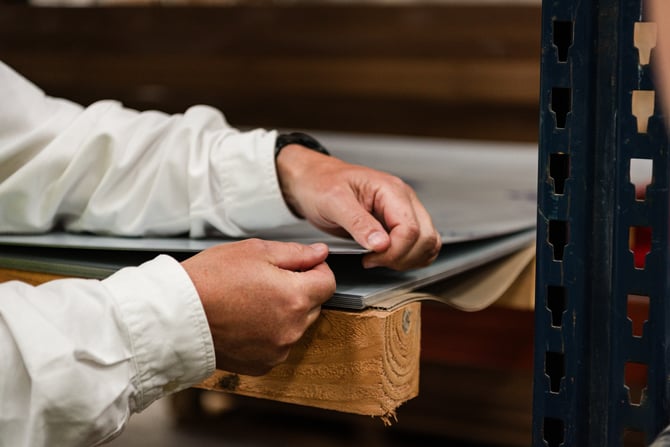
Solid aluminium sheet is the heavy-duty option of the four.
Where longevity, strength and a premium permanent installation are the priorities, aluminium can be an excellent choice. It is particularly useful where the sign needs to withstand demanding external conditions or where the specification calls for a solid metal substrate.
Advantages of Solid Aluminium
Excellent longevity
Properly specified and finished aluminium is highly suited to long-term exterior applications. Unlike plastic-based boards, there is no plastic core to deteriorate or become exposed at the edges.
Strong and rigid
Solid aluminium provides considerably more material strength than lightweight plastic boards, making it suitable for demanding installations.
Premium finish
Powder coating allows aluminium panels to be finished in a huge range of colours, helping create a clean, professional result for architectural and corporate signage.
No exposed plastic core
Cut edges remain aluminium, which can give fabricated panels a cleaner appearance than ACM where edges remain visible.
Disadvantages of Solid Aluminium
That additional performance comes with compromises.
Solid aluminium is heavier than ACM and plastic substrates, making larger sheets more demanding to handle and install.
It can also require more capable machinery to cut, drill and fabricate efficiently. For a small sign shop set up primarily around vinyl, printing and lightweight board processing, that can make bringing fabrication in-house less practical.
Unlike readily available coloured plastics, solid aluminium will also commonly require finishing, such as powder coating, where a particular colour is required. That adds another manufacturing stage and potentially additional lead time.
Finally, exposed metal can have scrap value. For signs installed in isolated or vulnerable locations, the potential for metal theft may be another factor worth considering during specification.
Best Uses for Solid Aluminium
Solid aluminium is worth considering for:
- Permanent external signage
- Architectural signage
- Premium corporate signs
- High-value wayfinding projects
- Signs in more demanding environments
- Fabricated sign components
- Projects where a long service life is more important than initial material cost
For permanent work, aluminium is often an investment in longevity rather than the cheapest way of producing the panel.
2. ACM: Aluminium Composite Material
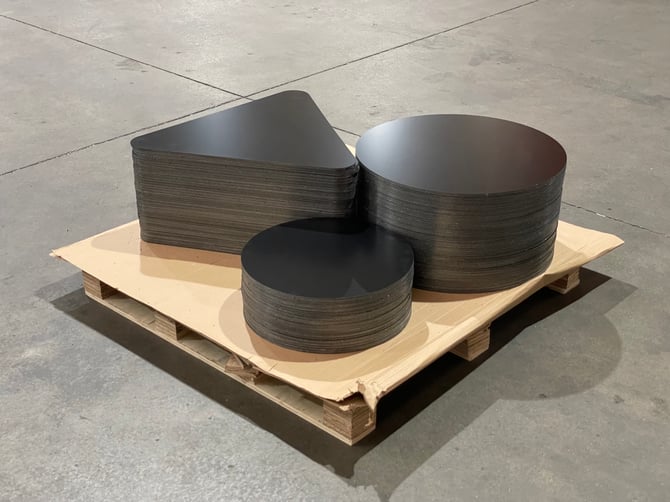
For everyday sign making, ACM is often the middle ground.
An ACM sheet uses thin aluminium skins bonded to a core. This construction produces a relatively rigid panel without the weight and cost associated with an equivalent solid aluminium sheet.
That combination has made aluminium composite one of the most familiar substrates in the sign industry.
Advantages of ACM
Excellent strength-to-weight ratio
ACM gives sign makers a useful level of rigidity while remaining relatively lightweight and straightforward to handle.
Easy to machine
ACM can be cut, drilled and routed using equipment commonly found in sign workshops, making it much more accessible than thicker solid metal.
Suitable for direct printing
Print-grade ACM can be printed directly using compatible flatbed printing equipment, removing the need to apply printed vinyl for suitable applications.
Dimensionally stable
Compared with expanded PVC boards, ACM is generally a better option where panel flatness and stability are important, particularly on external installations.
Surprisingly cost-effective
One of ACM’s biggest advantages is that the price difference between ACM and materials such as Foamex can be smaller than customers expect.
When the additional rigidity and external performance are considered, stepping up to ACM can represent good value.
What Are the Downsides of ACM?
The main compromises tend to be around finishing.
When ACM is cut, the edge reveals its layered construction rather than giving you a single self-coloured edge. Depending on the particular product, that can mean visible aluminium skins surrounding the core.
Corners can also feel sharper than Foamex, something worth considering for signs positioned where people may come into contact with the panel.
It is also important to remember that not every ACM product has the same specification.
Skin thickness, core composition, coating quality and fire performance can vary considerably. A low-cost sheet intended for temporary graphics should not automatically be treated as interchangeable with a product specified for demanding permanent or architectural applications.
Best Uses for ACM
ACM is a strong choice for:
- Shop signs
- External wall signs
- General business signage
- Directional signage
- Advertising boards
- Flat panel signs
- Printed display panels
- Tray and folded sign applications where the specific material is suitable
For many everyday external sign projects, ACM offers one of the best balances between price, weight, durability and ease of fabrication.
3. Foamex: Fast and Easy to Process
-1.png?width=670&height=279&name=Foam%20Stack%20Render%20(4)-1.png)
Foamex, commonly used as a name for expanded or foamed PVC sheet, is a favourite when speed and ease of manufacture matter.
It is lightweight, easy to cut and available in different thicknesses and colours.
For the right application, that makes it extremely useful.
Advantages of Foamex
Easy to cut and fabricate
Foamex can be machined quickly using standard sign-making equipment and is relatively forgiving to work with.
Excellent for direct printing
Its smooth surface makes print-grade Foamex a popular substrate for direct-to-board digital printing.
Lightweight
Panels are easy to handle, transport and position during installation.
Colour options
Foamex is available in various colours, depending on the manufacturer and grade. Unlike ACM, a coloured Foamex board can also provide a self-coloured edge when cut.
Ideal for quick-turnaround work
When a customer needs printed panels quickly, Foamex can be extremely efficient to produce.
Where Does Foamex Struggle?
The main consideration is environmental stability.
PVC foam sheet expands and contracts as temperatures change. On external signs, particularly darker boards or panels exposed to strong direct sunlight, thermal movement needs to be considered.
Poor specification or installation can result in panels bowing or warping.
Foamex is also less impact-resistant than aluminium-based alternatives and can crack or suffer damage if subjected to sufficient force, particularly depending on thickness, temperature and grade.
For that reason, it should not automatically be treated as a permanent external replacement for ACM or aluminium.
Best Uses for Foamex
Foamex is particularly useful for:
- Internal wall signs
- Retail graphics
- Point-of-sale displays
- Exhibition graphics
- Menu boards
- Short to medium-term promotional signage
- Printed display panels
- Internal directional signage
For internal signs and fast-turnaround printed graphics, Foamex remains an extremely useful material.
For long-term exposed exterior signage, however, it is worth asking whether ACM or aluminium would give the customer better value over the complete life of the sign.
4. Correx: The Temporary Signage Specialist
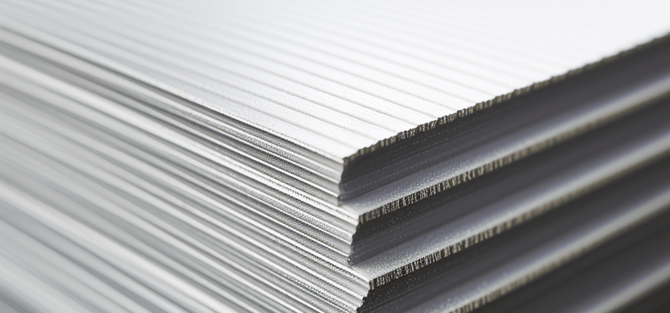
Correx is a fluted polypropylene sheet.
Its twin-wall construction keeps material use and weight low while creating enough rigidity for temporary signage applications. Genuine Correx is designed for printing and can be digitally, screen or flexographically printed depending on the product specification.
That combination makes it particularly attractive where the sign only needs to perform for a limited period.
Advantages of Correx
Low cost
Correx is generally the economical option when producing larger quantities of temporary signs.
Extremely lightweight
Signs can be transported and installed quickly, particularly useful for events, construction sites and temporary campaigns.
Printable
Suitable grades provide a surface designed for printing, making high-volume production relatively straightforward.
Easy to convert
Its construction allows sheets to be cut and converted quickly without heavy fabrication equipment.
Limitations of Correx
The very construction that makes Correx economical also creates its limitations.
Because the board is fluted, its rigidity differs depending on orientation. This needs to be considered when deciding how a panel will be mounted and how wind could act on it.
Thin sheets can also be crushed, creased, bent or torn much more easily than ACM or solid aluminium.
UV exposure is another important consideration.
Standard polypropylene can degrade with prolonged sunlight exposure. UV additives are available for some polypropylene sheet products, so it is important to check the actual board specification rather than assuming every Correx sheet will provide the same exterior life.
Corplex, the original UK manufacturer of Correx, lists optional UV additives for certain Correx Prime specifications.
Best Uses for Correx
Correx makes sense for:
- Construction site signs
- Health and safety notices
- Event signage
- Temporary directional signs
- Estate agency boards
- Promotional campaigns
- Short-term advertising
- Temporary notices
If the sign only needs to last weeks or months, there is little point over-specifying a permanent metal panel.
Equally, using a lightweight temporary board for something expected to remain installed for years is likely to create problems later.
Which Sign Material Should You Choose?
A useful way of making the decision is to start with how the sign will actually be used.
For permanent outdoor signage:
Consider solid aluminium or a correctly specified ACM.
Both provide considerably better options for long-term installations than lightweight temporary plastic boards.
For everyday external business signage:
ACM is often the practical choice.
It combines relatively low weight, good rigidity, straightforward fabrication and competitive pricing.
For internal printed signage:
Foamex is hard to beat for convenience.
It is quick to process, easy to print and available in useful thicknesses and finishes.
For temporary signage:
Correx usually makes the most commercial sense.
It keeps production, material and transport costs down without paying for durability the customer does not require.
For demanding or premium permanent projects:
Solid aluminium deserves consideration.
The additional fabrication and finishing requirements can be justified where strength, appearance and long service life are priorities.
Material Selection Is About More Than Sheet Price
For busy sign makers, the temptation is often to reach for whichever sheet is already on the rack.
But material price is only one part of the job.
Before specifying a substrate, consider:
How long does the customer expect the sign to last?
A six-week event sign and a ten-year building sign should not be specified in the same way.
Where will it be installed?
Internal, sheltered external and fully exposed external locations create very different demands.
How large is the panel?
As panel size increases, rigidity, thermal movement, wind loading, fixing centres and support become increasingly important.
How will it be fixed?
A substrate that works perfectly within a supported frame may behave very differently when installed as a large unsupported panel.
Will the edges be visible?
This can make the difference between choosing ACM and a self-coloured substrate for an appearance-sensitive installation.
What equipment do you have?
There is little commercial benefit in specifying a material that creates hours of additional fabrication work if another substrate can achieve the required result with the equipment already in your workshop.
What happens if the sign fails?
Returning to replace a warped or damaged sign can quickly wipe out whatever was saved by choosing the cheapest sheet.
ACM vs Aluminium vs Foamex vs Correx: The Bottom Line
There is no single substrate that wins every comparison.
Solid aluminium is the heavy-duty option when strength, longevity and a premium permanent finish are required.
ACM is the versatile all-rounder, providing a strong combination of rigidity, low weight, machinability and value.
Foamex is the fast and convenient option for printed displays, internal signs and shorter-term applications.
Correx is the economical temporary solution, particularly useful for events, construction, promotional and health and safety signage.
The important thing is matching the substrate to the project rather than simply specifying what you normally use.
For small sign-making teams, having access to the right materials, components and technical advice can also make it easier to confidently quote projects outside your normal day-to-day work.
At Sign Trade Supplies, our approach is focused on helping UK sign makers find practical solutions for the job in front of them. Alongside supplying sign-making materials, aluminium profiles, fixings and signage systems, our team can help customers work through product and project requirements.
With no MOQs across core ranges and nationwide delivery, sign makers can order around the project they are working on rather than holding unnecessary stock.
Because when deadlines are tight, the right substrate is only useful if you can get the materials, components and support you need to finish the job.